How to Choose the Right Brick Repointing Contractor
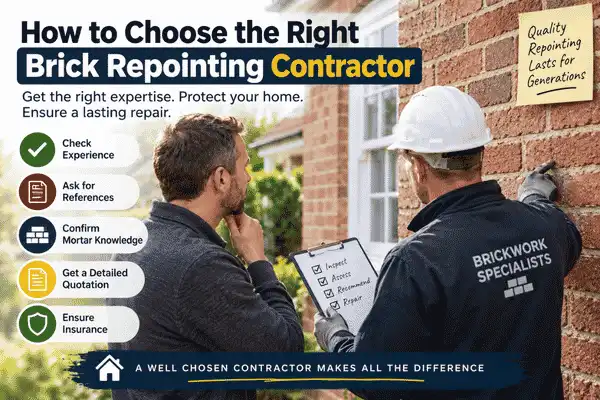
Choosing the right brick repointing contractor can prevent poor workmanship, damaged bricks, and unnecessary repair costs. Look for experience with your type of property, suitable mortar knowledge, clear written quotations, proper preparation, and safe working practices. Do not choose a contractor based only on the lowest price. The quality of the repair matters just as much as the cost.
Brick repointing is more than filling gaps between bricks. The old mortar must be removed carefully, the joints prepared correctly, and suitable new mortar applied.
Poor repointing can cause cracked joints, damaged brick faces, water penetration, and an uneven appearance.
An experienced contractor should understand how different bricks and mortars behave before starting the work.
Start by checking the contractor’s experience and previous work.
Ask:
Clear answers can help you understand whether the contractor has the right experience for your property.
Yes, particularly if you own a Victorian, Georgian, Edwardian, or other traditional property.
Older buildings may contain softer bricks and lime-based mortar. These materials require a different approach from many modern brick walls.
A contractor experienced with traditional masonry should understand the importance of mortar compatibility.
Using an excessively hard mortar on softer historic bricks can contribute to brick deterioration.
Mortar selection is one of the most important parts of repointing.
A suitable mortar should work with the existing brickwork rather than simply being chosen for maximum strength.
For example, many traditional buildings use lime mortar because it allows moisture to move through the joints.
Modern cement-based mortar may be appropriate for many newer properties.
The correct choice depends on the existing construction.
Yes.
A proper inspection provides a much better basis for a quotation than a price based only on photographs.
During an inspection, the contractor should assess:
A detailed inspection can also identify repairs that may need to happen before repointing.
A professional quotation should clearly explain what you are paying for.
Ideally, it should include:
| Item | What to check |
|---|---|
| Area of work | Which walls or sections are included |
| Mortar | Type and finish proposed |
| Preparation | How old mortar will be removed |
| Scaffolding | Whether it is included |
| Materials | Mortar and replacement bricks |
| Labour | Installation and finishing |
| Cleaning | Whether the wall will be cleaned afterwards |
| Waste removal | Whether old mortar and debris are removed |
| Additional repairs | Any exclusions or potential extra costs |
Avoid accepting a vague quotation that only gives one total price.
Yes.
Getting two or three detailed quotations can help you compare contractors properly.
Do not compare only the final price.
One contractor may quote less because they have excluded scaffolding, preparation, waste removal, or sections of damaged brickwork.
A slightly higher quotation may provide better value if it includes the complete repair.
Before agreeing to the work, ask practical questions.
The contractor should explain why the proposed mortar is suitable for your brickwork.
The answer should reflect the condition and construction of the existing joints.
Careful mortar removal is important because aggressive methods can damage brick faces.
Ask whether scaffold costs are included in the quotation.
The quotation should explain how additional repairs will be handled.
The contractor should provide a realistic timeframe while allowing for weather conditions.
Several warning signs should make you cautious.
Avoid contractors who:
A professional contractor should be willing to explain the work clearly.
Not necessarily.
Repointing involves skilled labour, and cutting corners can affect the final result.
For example, removing mortar too aggressively may damage bricks. Using an unsuitable mortar can create problems later.
Compare the scope of work, materials, experience, preparation, and guarantees before choosing a contractor.
Yes.
Reviews can provide useful information about communication, workmanship, punctuality, and customer experience.
However, do not rely on reviews alone.
Ask to see previous repointing projects, particularly properties that are similar to yours.
Photos can help you assess the quality and consistency of the finished joints.
You should confirm that the contractor has appropriate insurance for the work they undertake.
Ask what cover they have and what it includes.
This is particularly important when work involves scaffolding, chimneys, multiple workers, or larger properties.
You should also confirm who is responsible for any accidental damage during the project.
A knowledgeable contractor should be able to discuss the relationship between bricks and mortar.
They should understand that older walls may need softer, more breathable materials.
They should also explain why the existing mortar needs to be assessed before selecting a replacement.
Be cautious if someone recommends a hard cement mortar without considering the age or condition of the building.
A typical project involves several stages:
The exact process varies depending on the property and mortar condition.
Choosing a suitable contractor starts with understanding what your brickwork actually needs.
Brick Repointing Experts can assess the condition of the existing mortar and brickwork before recommending a suitable repointing approach. This is particularly important for older properties where mortar selection and careful preparation can affect the condition of the original bricks.
The aim should be to repair deteriorated joints without causing unnecessary damage to sound masonry.
Related services may include:
Use this checklist before making your decision:
The best contractor should be able to explain both what they will do and why they recommend it.
The right contractor should understand your property, inspect the existing masonry, recommend compatible materials, explain the work clearly, and provide a detailed quotation.
Do not judge a repointing contractor by price alone. Good preparation, correct mortar selection, careful workmanship, and proper finishing are what make a repointing repair worthwhile.
The cost depends on the size of the property, condition of the mortar, building height, access, scaffolding, mortar type, and amount of preparation required. A contractor should inspect the property before providing a detailed quotation.
The timeframe depends on the size and condition of the building. A small repair may take considerably less time than repointing several elevations of a house. Weather can also affect the work and mortar curing process.
Some builders have suitable masonry experience, but repointing requires specific knowledge of mortar, brickwork, joint preparation, and finishing. For older properties, choose someone with experience in traditional masonry.
A local contractor can be useful because they may have experience with common building types and brickwork in the area. However, experience and workmanship should still be your main considerations.
Repointing replaces deteriorated mortar while keeping the existing bricks. Rebuilding removes and reconstructs the brickwork. If the bricks remain structurally sound, repointing may avoid the need for more extensive work.
Yes. Poorly completed pointing may leave gaps, cracks, or unsuitable joints that allow water to enter the wall. If damp is present, the underlying cause should be identified rather than assuming repointing alone will solve it.
Many traditional buildings were constructed using lime mortar, but this should be confirmed before work begins. The replacement mortar should be compatible with the existing bricks and construction.
A quotation should clearly identify the areas being repaired, mortar type, preparation, labour, scaffolding, materials, cleaning, waste removal, and any exclusions. This makes it easier to compare quotations accurately.
Ask about their masonry experience, previous projects, insurance, and approach to mortar selection. You can also ask for references or examples of completed work similar to your property.
Good workmanship can be worth the additional cost because incorrect mortar or poor preparation may cause further brickwork problems. Compare the complete scope of work rather than choosing a contractor solely by price.