Brick Repointing vs Tuckpointing: What’s the Difference?
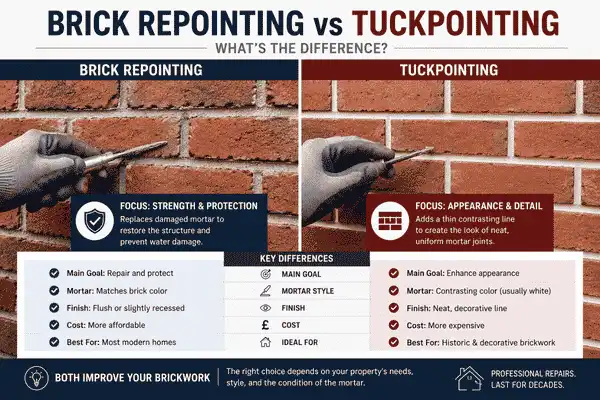
Brick repointing and tuckpointing are often confused because both involve repairing mortar joints. The main difference is their purpose. Repointing replaces damaged mortar to strengthen brickwork and stop water damage, while tuckpointing improves the appearance of brick walls by creating the illusion of fine, even joints. Knowing which service your property needs can save money and protect your brickwork.
Brick repointing is the process of removing old or damaged mortar from between bricks and replacing it with new mortar.
Mortar naturally wears away over time because of rain, frost, wind, and temperature changes. When this happens, gaps allow moisture to enter the wall.
Replacing the damaged mortar restores the strength of the brickwork and helps prevent further deterioration.
Professional repointing focuses on preserving the structure rather than changing its appearance.
Tuckpointing is a decorative brick finishing technique.
After new mortar is applied, a narrow line of contrasting mortar is placed down the centre of each joint.
This creates the appearance of perfectly uniform mortar joints, even when the bricks themselves are slightly uneven.
Tuckpointing became popular during the Georgian and Victorian periods and is still used on many heritage buildings throughout the UK.
Unlike standard repointing, tuckpointing combines structural repair with decorative craftsmanship.
The confusion comes from the fact that both services involve replacing mortar.
However, the objectives are different.
Repointing focuses on repairing damaged mortar to protect the building.
Tuckpointing focuses on improving the appearance of brickwork while also renewing mortar joints.
Many homeowners use the terms interchangeably, but professional bricklayers treat them as separate techniques.
| Feature | Brick Repointing | Tuckpointing |
|---|---|---|
| Main purpose | Repair damaged mortar | Improve appearance while repairing mortar |
| Structural benefit | Yes | Yes |
| Decorative finish | Standard | High-quality decorative finish |
| Labour required | Moderate | High |
| Skill level | Skilled masonry | Specialist craftsmanship |
| Cost | Usually lower | Usually higher |
| Suitable for | Most residential properties | Heritage and decorative brickwork |
| Visual appearance | Natural mortar joints | Thin, perfectly aligned joints |
For most modern homes, repointing is the recommended option.
Tuckpointing is commonly chosen when preserving the original architectural character is important.
Brick repointing is the right choice when mortar has started to fail.
Typical warning signs include:
These problems affect the strength of the wall rather than its appearance.
Replacing damaged mortar early helps prevent more expensive repairs later.
Tuckpointing is best suited to buildings where appearance is just as important as structural integrity.
Examples include:
Many older buildings originally featured tuckpointing.
Restoring this finish helps preserve their historical appearance while renewing deteriorated mortar.
In most cases, tuckpointing costs more than standard repointing.
The reason is simple.
Creating perfectly straight decorative lines requires considerable skill and additional labour.
Every joint takes longer to complete.
Repointing is generally more economical because it focuses on restoring the mortar without adding decorative detailing.
No. Many modern homes were never built using tuckpointing.
Applying decorative tuckpointing to a property that never originally had it is often unnecessary.
Professional bricklayers usually recommend matching the property’s original style rather than changing it.
Yes. Fresh mortar makes brick walls look cleaner and more defined.
Even without decorative tuckpointing, removing damaged mortar often transforms the appearance of a building.
Many homeowners are surprised by how much brighter their brickwork looks after professional repointing.
Not all mortar is suitable for every building.
Older UK homes often require lime mortar because it allows moisture to escape naturally.
Using hard cement mortar on historic brickwork can trap moisture and damage older bricks.
Matching the new mortar to the existing construction is one of the most important parts of a successful repair.
Professional inspections help determine which mortar is appropriate for the property.
Brick repointing follows a structured process to restore the strength of masonry without changing the original appearance of the wall.
A professional repointing project usually includes these steps:
Each stage helps create a durable repair that protects the wall from water penetration.
Tuckpointing begins with the same repair process as repointing.
Once the damaged mortar has been replaced, an additional decorative step is completed.
The process typically includes:
The final result creates the appearance of perfectly even brick joints, even if the original bricks vary in size.
When completed correctly, both brick repointing and tuckpointing can last for many years.
The lifespan depends more on workmanship, materials, weather exposure, and maintenance than on the technique itself.
Factors that influence durability include:
Regular inspections help identify small areas of damage before larger repairs become necessary.
Several factors influence the cost of both services.
Larger walls require more labour, materials, and time.
Two-storey houses, chimneys, and commercial buildings often require scaffolding.
Scaffolding can significantly affect the total project cost.
Deeply damaged mortar requires more preparation before new mortar can be installed.
Historic buildings often require specialist knowledge and traditional lime mortar.
These projects generally take longer to complete.
Tuckpointing involves additional craftsmanship.
The decorative finishing stage increases labour time compared with standard repointing.
In most cases, yes.
Modern homes are usually built with consistent brickwork that does not require decorative tuckpointing.
Standard repointing restores the mortar, improves weather resistance, and maintains the property’s appearance without unnecessary decorative work.
For many homeowners, this provides the best balance between cost and long-term protection.
Tuckpointing is often the preferred choice for historic buildings that originally featured this finish.
Many Georgian and Victorian properties were designed with fine, decorative mortar joints.
Restoring these details helps preserve the building’s original character while repairing deteriorated mortar.
Owners of listed buildings should always seek professional advice before beginning masonry repairs, as local planning requirements may apply.
Brick repointing offers several practical benefits.
Tuckpointing provides both structural and visual benefits.
Every repair method has limitations.
| Brick Repointing | Tuckpointing |
|---|---|
| Does not create decorative joints | Higher labour costs |
| Appearance depends on existing brickwork | Requires specialist craftsmanship |
| May not restore original historic detailing | Takes longer to complete |
| Requires suitable weather conditions | More expensive to maintain decorative finish |
Choosing the right method depends on the property’s age, condition, and architectural style.
Many brickwork problems become more expensive because repairs are delayed.
Common mistakes include:
Small mortar cracks can develop into widespread deterioration.
Early repairs are usually less expensive.
Using cement mortar on older lime-built properties may trap moisture and damage historic bricks.
Matching the original mortar is essential.
The cheapest quotation is not always the best value.
Poor workmanship may require the work to be repeated.
Chimneys experience constant exposure to rain, frost, and wind.
Minor mortar damage can quickly become more serious if left untreated.
Paint hides visible defects but does not repair deteriorated mortar.
Moisture can continue entering the wall behind the surface.
Choosing an experienced contractor helps ensure repairs last for many years.
Look for a company that:
A thorough survey often produces a more accurate recommendation than a quotation based only on photographs.
Every property is different, and the correct repair method depends on the condition of the mortar, the type of brickwork, and the age of the building.
Brick Repointing Experts assess existing mortar, identify the underlying cause of deterioration, and recommend whether standard repointing or decorative tuckpointing is the most suitable solution. Their approach focuses on preserving the integrity of the brickwork while matching the property’s original appearance wherever possible.
You may also find these services useful:
Brick repointing and tuckpointing both restore damaged mortar, but they serve different purposes. Repointing focuses on protecting the structure by replacing deteriorated mortar, making it the best choice for most modern homes. Tuckpointing combines structural repair with decorative detailing and is commonly used on Georgian, Victorian, and other heritage properties.
If you’re unsure which method your property needs, a professional inspection is the safest approach. Identifying the correct repair early can prevent water damage, preserve the appearance of your brickwork, and help avoid more costly repairs in the future.